Post RFQ
Service Hotline
19920083827
Tick the specs you need to submit them together; or enquire one by one. Cat. numbers are carried into the RFQ.
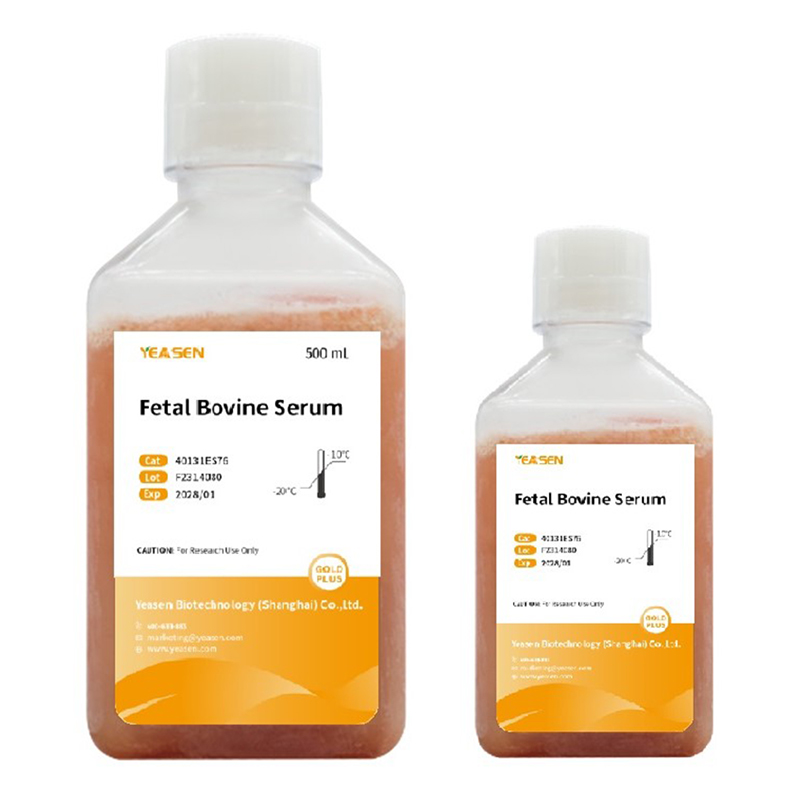
Q:血清融化后有细沙状的沉淀,是什么呢?
A:血液中的钙离子部分与磷酸结合形成磷酸钙沉淀,血清是来源于血液,血清中也有磷酸钙存在,尤其在37°C培养的时候会增加,会造成血清的浑浊,这种沉淀物在倒置显微镜下观察像小黑点,并且由于布朗运动看上去像在活动,因此经常被误认为是微生物污染。磷酸钙沉淀是不影响使用的,可以1000-2000rpm,离心10 min去除。
Q:解冻后血清中有悬浮物质/絮状沉淀,是什么原因呢?需要怎样处理?
A:血清中沉淀物的出现有许多种原因,但最普遍的原因是由于血清中脂蛋白的变性所造成,而血纤维蛋白(形成凝血的蛋白之一)在血清解冻后,也会存在于血清中,亦是造成沉淀物的主要原因之一。但这些絮状沉淀物,并不影响血清本身的质量。
欲去除这些絮状沉淀物,可以将血清分装至无菌离心管内,以400 g稍微离心,上清液即可接着加入培养基内一起过滤。我们不建议您以过滤的方法去除这些絮状物,因为它可能会阻塞您的过滤膜。我们建议您在使用血清的时候,注意正确的血清解冻步骤,并尽量避免灭活血清及长时间的将血清置于高温环境中。
Q:血清正确的溶解方式及灭火方法?
A:-20℃拿出血清后放置于2℃至8℃冰箱中过夜,融化过程中可以混匀几次。完全融化的血清可以放到室温恢复到室温,然后直接分装,把血清放在 37℃ 环境中,又会使此沉淀物更增多。如果是做普通的细胞培养实验不建议灭活处理,如果必须灭火处理可以56℃水浴30 min处理,融化过程中摇匀几次,灭火的影响如下。
Q:血清融化后有必要灭火吗?
A:大多数的细胞而言是不需要灭火的。经此处理过的血清对细胞的生长只有微小的促进,或完全没有任何作用,甚至通常因为高温处理影响了血清的质量,而造成细胞生长速率的降低。而经过热处理的血清,沉淀物的形成会显著的增多, 这些沉淀物在倒立显微镜下观察,像是 "小黑点",常常会让研究者误以为是血清污染。
Published citations
[1] Yijun Mei, Deyi Zhang, et al. One-stone-three-birds strategy: a graphdiyne oxide nanosheet-involved drug-formed immune-boosting hydrogel with dual responsivity for triple-modal cancer immunotherapy, Materials Today, Volume 89, 2025, Pages 67-83, ISSN 1369-7021, https://doi.org/10.1016/j.mattod.2025.07.021. (IF:22.0)
[2] S. Zou, Q. Zhang, M. Guo, et al. “ Radiofrequency Dynamic Therapy on Cancer of Gallium–Indium Liquid Metal Nanoemulsion Stabilized by Gold Nanoclusters.” Adv. Funct. Mater. 35, no. 38 (2025): 2425330. https://doi.org/10.1002/adfm.202425330. (IF:18.5)
[3] Deng J, Wang Z, Wu L, Song Z, Bahlol HS, Li X, Zhao L, Han H. Metal-Phenolic Network Hydrogel Vaccine Platform for Enhanced Humoral Immunity against Lethal Rabies Virus. ACS Nano. 2025 Mar 11;19(9):9042-9052. doi: 10.1021/acsnano.4c17759. Epub 2025 Mar 2. PMID: 40025824. (IF:15.8)
[4] Li J, Yang R, Zhang C, Lovell JF, Zhang Y. Manganese-Driven Plasmid Nanofibers Formed In Situ for Cancer Gene Delivery and Metalloimmunotherapy. J Am Chem Soc. 2025 Mar 26;147(12):10504-10518. doi: 10.1021/jacs.4c18511. Epub 2025 Mar 10. PMID: 40065259. (IF:14.4)
[5] Qiu Q, Li J, et al. Zinc Coordination Lipid Nanoparticles Co-Delivering Calcium Peroxide and Chelating STING agonist for Enhanced Cancer Metalloimmunotherapy. Small. 2024 Nov;20(46):e2402308. doi: 10.1002/smll.202402308. Epub 2024 Aug 8. PMID: 39114869. (IF:13)
[6] Xian P, Zou L, et al. Precision targeted cancer-associated fibroblast nano-regulator enhanced chemo-immunotherapy for triple-negative breast cancer. Biomaterials. 2026 Mar;326:123679. doi: 10.1016/j.biomaterials.2025.123679. Epub 2025 Sep 4. PMID: 40939259. (IF:12.9)
[7] Xu W, Wang S, Zhang J, Wang F, Sun Z, Liu B, Ye J, Chu H. A minimalist self-assembly nanosystem for cancer immunotherapy via multiple immune activation. J Nanobiotechnology. 2025 Jun 2;23(1):410. doi: 10.1186/s12951-025-03464-1. PMID: 40457253; PMCID: PMC12131631. (IF:12.6)
[8] Li T, Cai M, et al. A solvent-free ropivacaine-loaded composite hydrogel assembled from pH-sensitive micelles and a thermosensitive injectable hydrogel for prolonged local anesthesia. Acta Biomater. 2025 Dec;208:309-321. doi: 10.1016/j.actbio.2025.11.005. Epub 2025 Nov 5. PMID: 41202905. (IF:10.3)
[9] He L, Yin R, et al. Oxygen Glucose Deprivation-Induced Lactylation of H3K9 Contributes to M1 Polarization and Inflammation of Microglia Through TNF Pathway. Biomedicines. 2024 Oct 17;12(10):2371. doi: 10.3390/biomedicines12102371. PMID: 39457683; PMCID: PMC11504212. (IF:3.90)
[10] Ma B, Shi S, et al. Liensinine, a Novel and Food-Derived Compound, Exerts Potent Antihepatoma Efficacy via Inhibiting the Kv10.1 Channel. J Agric Food Chem. 2024 Mar 6;72(9):4689-4702. doi: 10.1021/acs.jafc.3c06142. Epub 2024 Feb 21. PMID: 38382537. (IF:6.1)