
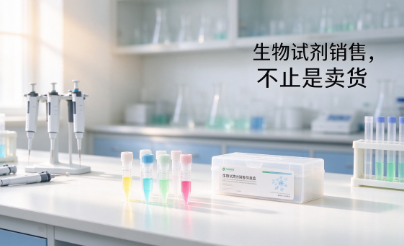
Many people who have just entered the industry think that working in bioreagent sales means making phone calls, visiting labs, and competing on price. After doing it for a while, they understand: winning orders by low price only earns a little money, and once the customer switches suppliers, you are gone. What truly allows you to make money over the long term is not selling the reagent itself, but making yourself someone the research lab cannot do without.
This industry has barriers to entry, and once customer stickiness is established, repeat purchases can continue for several years. If you do it well, your income is very stable, and the longer you do it, the more in demand you become.
First, get orders moving in the short term
Let us start with what is right in front of you: how to quickly close orders and earn profit.
Bioreagent customers can roughly be divided into several types: university research labs, hospital clinical laboratories, third-party testing companies, and biopharmaceutical companies. Each type of customer requires a completely different approach.
With universities, what professors and graduate students care about most is not price, but whether the product is stable, whether shipping is fast, and whether someone takes responsibility when problems arise. Many graduate students are running experiments, and if something goes wrong with a reagent, an entire batch of samples can be ruined, directly delaying thesis progress. They would rather spend a bit more to buy something reliable.
For corporate customers, what matters is whether qualifications are complete, whether batches are stable, and whether invoicing and supply can keep up. Volumes are large and order values are high, but the review cycle is long, so there is no rushing it.
The mistake new salespeople make most easily is cutting prices as soon as they start. Reagent profit margins may look high, but costs such as logistics, cold chain, and returns and exchanges are not low. If you win a customer through low price, then once upstream prices rise or a batch has quality problems, you have no profit margin left to provide after-sales service, and the customer will turn around and leave.
So what is the right approach for closing orders in the short term? First, find precise demand; do not blindly canvass buildings. Learn what topic the lab is currently working on, which brand of reagents it uses, and whether it often encounters problems such as contamination, unstable amplification, or insufficient titer during experiments. Only after finding the pain point should you promote products. Help them solve troubles in their experiments, and your quote will be more easily accepted while protecting your profit.
Do not give out samples randomly
Sample trials are a very useful tool in this industry, but they cannot be given out casually. Many salespeople, in order to attract customers, give samples everywhere and for free, spend a pile of money on costs, and in the end do not convert a single order.
Before sending samples, you must discuss several things clearly with the customer: what protocol you plan to use, what results are expected, and how long it will take to finish testing. Then agree that if the results are fine, roughly how much they will purchase afterward. Only then can the money spent on samples possibly turn into orders, with costs under control.
What does long-term profitability depend on?
If you want to last, you cannot just be an order-taking salesperson; you must gradually become a technical consultant to the lab.
Customers in this industry place great importance on professionalism. If you can understand basic experimental principles, help customers analyze why an experiment failed, and know the differences between different batches of reagents, how to store them, and what to pay attention to during operation, then customers will trust you.
Many times, what customers buy is not just the reagent, but the accompanying technical support. For example, if a customer cannot get a band in PCR amplification, and you can help troubleshoot the cause, even if it ultimately turns out not to be a reagent problem, the customer will remember that you are reliable and think of you first for future purchases.
Repeat purchases from long-term customers are the source of stable income. A stable lab customer may purchase from you dozens of times a year, without you needing to repeatedly develop new customers.
Customers should be managed by tier
Divide customers into three categories: A, B, and C.
Category A are major customers, such as pharmaceutical companies and large testing institutions. Order amounts are large, but maintenance costs are also high. They require regular on-site visits, follow-up on new projects, advance stocking, and guaranteed supply.
Category B are mid-sized labs with relatively stable repeat purchases. Online plus offline maintenance is enough: regular follow-ups, and priority promotion of new products to them.
Category C are small customers, such as small research groups. Single orders are not large, and maintenance through WeChat and online communication is sufficient; there is no need to spend too much time.
Energy should be focused on high-value customers. Do not spend too much time on those who only compare prices and hardly ever place orders.
Compliance is the bottom line
Bioreagents involve cold-chain transportation, product qualifications, invoicing, and import and export documents. Never cross the red line on these things. Do not sell reagents of unknown origin or without quality inspection reports. Once a quality accident occurs, you will not only lose customers but also face legal risk.
Inventory and delivery must also be anticipated in advance, especially for low-temperature reagents. Incidents such as cold-chain damage or product failure upon arrival can destroy trust you have built up over a long time in an instant.
How to grow over the long term
Customer labs change research topics, and companies launch new projects, so you must continuously follow up on new needs. Usually, accumulate industry connections and talk more with upstream and downstream suppliers and experimental technical personnel. As your reputation gradually builds, old customers will also help introduce you to new labs.
This industry is not a young person's game; it relies on customer accumulation and technical experience.Things will indeed be slower in the early stage, as it takes time to learn experimental knowledge and build up a customer base. Once you get past the startup phase, sustained repeat purchases will make your income increasingly stable.
To put it simply, there are just two points: short-term profitability depends on precisely identifying needs, offering reasonable trial use, and avoiding blind price cutting; long-term profitability depends on professional technical service, customer accumulation, and holding the bottom line on compliance. In the bioreagent sector, making quick money is not easy, but if you dig deep and rely on stable repeat purchases, it can be a business you can keep doing for the long haul.
Sign in to comment on this article
试剂毛利差别大,耗材走量、特种抗体看服务,做实验室要懂技术。
销售不是拼关系,复购和交付稳定才赚钱,货期一慢客户就换家。